Grow a Dense Utricularia Graminifolia Carpet Without Melting
Why UG Melts in the First Place
Utricularia graminifolia (UG) has no true roots. It’s a carnivorous bladderwort that absorbs nutrients through hair-thin rhizomes and tiny leaves, which is exactly why it reacts so badly to being moved from one tank to another. Plant it on a Saturday and by the following weekend half of it can look like soup. That’s not necessarily a disaster, but let’s talk about why it happens.
A few things usually trigger the collapse:
- Emersed-to-submersed shock. Most UG sold in stores was grown emersed, in trays above water. The moment you drop it underwater, the old leaf form starts dying back before the plant can push out new, aquatic-adapted leaves.
- Not enough light actually hitting the substrate. It’s not about how bright your tank looks from the glass. UG needs real intensity down at soil level, where the rhizomes sit.
- CO2 that isn’t high or stable enough. UG grows fast when it’s happy, and fast growth needs fuel, somewhere around 25-30 ppm, consistently, not just on Tuesdays.
- Planting in thick clumps, too deep. Bury a dense wad of UG and the center suffocates. No flow, no light, no oxygen, just slow rot.
- A bacterial bloom right after planting. Disturbed substrate leaks ammonia and organic matter into the water, and that’s enough to stress rhizomes that are already struggling to adjust.
Here’s the thing worth remembering: melting in the first one to two weeks is basically par for the course. You’re not trying to prevent it entirely. You’re trying to make sure the rhizome network underneath survives the ordeal, because that’s what regrows into a thick mat.
Step 1: Choose the Right Substrate
UG does best in a fine, nutrient-rich aqua soil, something in the 1-3mm grain range. Skip gravel or anything coarse. The rhizomes are basically threads; they can’t grip chunky substrate, and light gets blocked before it reaches the base.
- Go with a soil-based product (ADA Amazonia, Fluval Stratum, or an equivalent).
- Keep the layer around 3-5cm (roughly 1.2-2 inches) deep. Deep enough to tuck rhizomes in, shallow enough that light still gets through.
- Only cap with a thin layer of fine sand if you’re fighting serious nutrient leaching. Otherwise leave it bare. UG actually prefers direct contact with the soil.
Step 2: Planting Technique That Minimizes Shock
- Pull the mesh apart completely. Don’t plant the store mat as one piece. Use tweezers and break it down into pea-sized tufts.
- Space it out, don’t cram it in. Sounds backwards, but planting thin clumps 1.5-2cm apart gives you a denser carpet down the road than jamming in thick mats. Spacing lets light and water movement reach every single rhizome instead of just the outer edge.
- Keep it shallow. Rhizomes want to be just barely covered, maybe 2-3mm. Bury them any deeper and they rot before they get a chance to photosynthesize.
- Rinse off whatever the emersed growth was potted in (rockwool, foam, whatever) before it goes anywhere near your substrate. That stuff invites fungus and bacteria if left on.
Step 3: Lighting and CO2, the Non-Negotiables
Make no mistake, UG is a high-tech plant. It’ll limp along under weak light and inconsistent CO2, but it will never actually carpet.
- Light: aim for 50-80 PAR at the substrate. A decent mid-to-high output LED, something like a Chihiros WRGB II, over a 30-45cm tall tank gets you there.
- Photoperiod: start at 6-7 hours a day. Don’t stretch the hours to make up for weak intensity, that’s a shortcut straight to an algae outbreak, not growth.
- CO2: inject from day one, roughly 1 bubble per second per 10 gallons as a starting point, then fine-tune against your drop checker (you want it sitting between lime-green and yellow-green). Start the CO2 one to two hours before the lights kick on.
- Flow: keep it strong and even across the substrate. Weak flow lets detritus and mulm settle into the carpet, and that’s a direct path to brown and black patches, plus melt in those exact spots.
Step 4: Nutrient Dosing During Establishment
UG is carnivorous by nature, sure, but in an aquarium it leans heavily on water column nutrients, especially while it’s melting and trying to regrow.
- Dose a complete liquid fertilizer (nitrogen, phosphorus, potassium, plus micros, iron in particular) three times a week.
- Keep root tabs away from UG specifically. A concentrated pocket of nutrients right under those shallow rhizomes can burn them.
- Target roughly 10-20 ppm nitrates and 1-2 ppm phosphates while it’s carpeting.
Step 5: Trimming for Density, Not Height
Once the new growth hits about 1-1.5cm (usually three to four weeks after planting), start trimming lightly.
- Snip the top third with curved scissors every 7-10 days.
- This is the key trick: trimming pushes the rhizomes to branch sideways instead of just growing up. That lateral branching is literally what builds density. Left untrimmed, UG just grows tall and sparse, more like patchy grass than a carpet.
- Siphon out the clippings right away. Leave them sitting in the carpet and they’ll rot, and rotting clippings cause their own little melt spots.
Troubleshooting Common Problems
- Brown or melting patches in the middle of the carpet: almost always poor flow or trapped detritus under thick growth. Boost flow and manually clean the spot.
- Carpet growing up instead of spreading out: light’s too weak or CO2 isn’t stable. Check your drop checker color first, then nudge the light intensity up a bit.
- New growth coming in yellow: classic sign of a micronutrient shortage, iron especially. Dose fertilizer more often.
- Carpet lifting off the substrate in sheets: usually gas building up underneath a thick mat in a low-flow tank. Thin it out in sections so the gas has somewhere to escape.
Conclusion
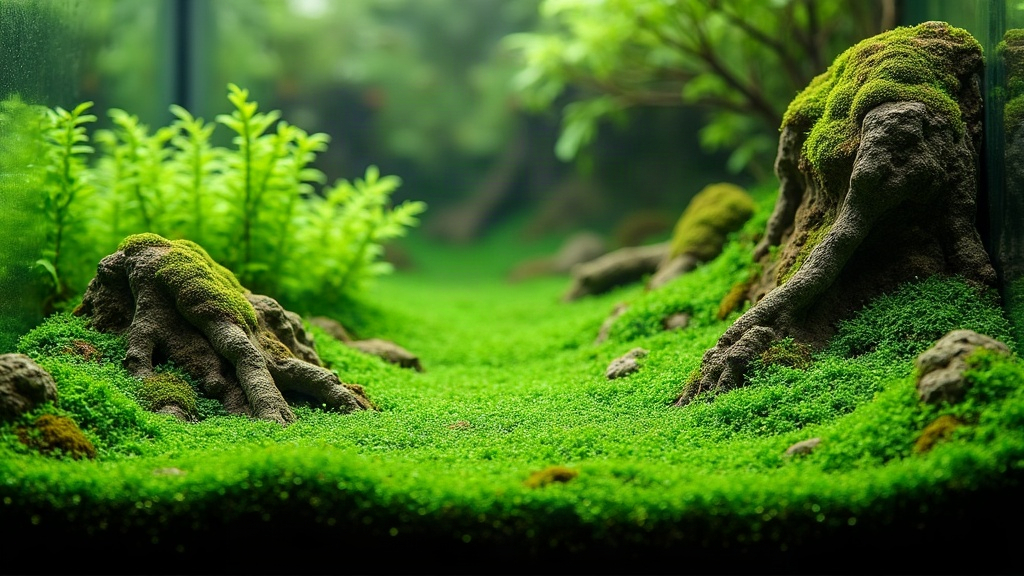
A dense UG carpet is well within reach if you’re an intermediate-to-advanced aquarist willing to control the fundamentals: fine, nutrient-rich substrate, shallow and spaced-out planting, high and consistent light plus CO2, strong flow, and a disciplined trimming routine that forces lateral growth. Expect melt early on, treat it as normal, not a failure. What actually matters is keeping the rhizome network alive underneath so it can bounce back into that famous lawn-like mat. Stay consistent with your parameters and most tanks will show a real, walkable carpet somewhere around the six to eight week mark.