Inline Atomizer vs Bazooka Diffuser: 40-Gallon High-Tech Tank
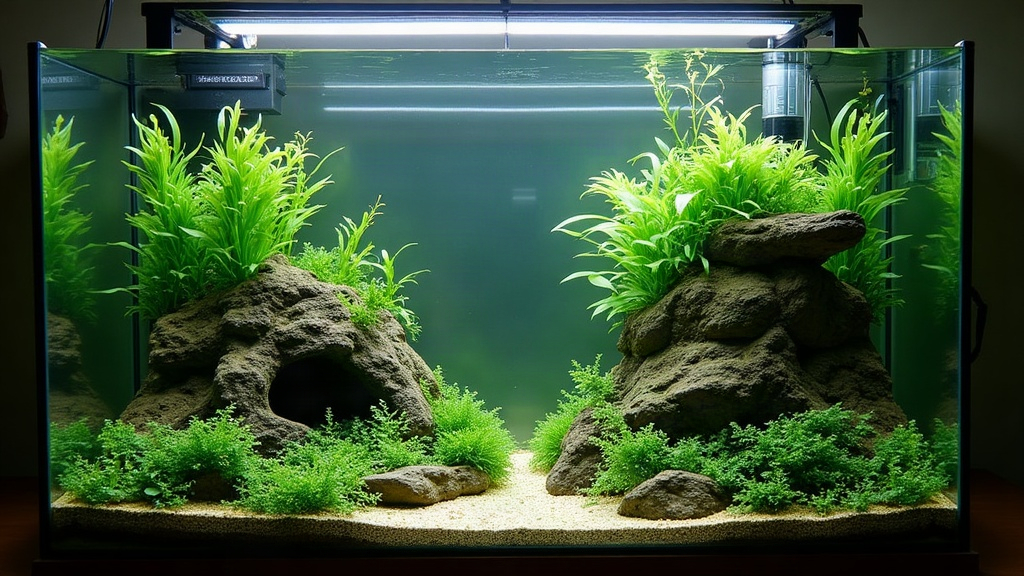
If you’re running a 40-gallon high-tech planted tank, the choice between an inline atomizer and a bazooka diffuser really comes down to three things: how much CO2 your plants are demanding, how much spare flow your canister has to give up, and how much micro-bubble haze you’re willing to put up with in the water column. For most 40-gallon setups running a mid-size canister (say, 250-400 GPH), a bazooka diffuser gets the job done with less fuss and less money. An inline atomizer, on the other hand, gives you finer mist and tighter dissolution, but only if your filter has flow to spare.
This guide walks through both so you can pick the method that actually fits your bioload, plant density, and filtration setup, not just whatever looks cool on a forum thread.
How Each Diffuser Works
Bazooka Diffuser
A bazooka diffuser lives inside the tank, usually tucked behind a piece of driftwood or buried in a plant cluster. CO2 enters a small chamber and pushes through a ceramic disc, releasing a stream of fine bubbles that drift upward through the water. Flow from your filter’s spray bar (or a powerhead aimed at the disc) blasts across the face of the diffuser to break those bubbles up and scatter them around the tank.
- Pros: Dead simple to install, zero plumbing changes, you can literally count bubbles to check your dosing, and it works regardless of what filter you’re running.
- Cons: Eats into your tank space, the ceramic disc needs a vinegar soak every so often to clear biofilm, and if your flow is weak, bubbles can slip past and off-gas at the surface before they dissolve.
Inline Atomizer
An inline atomizer goes inside the canister’s output tubing, right before the water dumps back into the tank. CO2 gets injected into the line, and the atomizer (ceramic core or a spinning mechanism, depending on the brand) pulverizes it into an ultra-fine mist that gets shot into the aquarium with the full force of the filter’s output.
- Pros: Near-100% dissolution when flow is adequate, nothing cluttering the inside of the tank, and even CO2 distribution across the whole layout.
- Cons: Adds backpressure and chokes flow somewhat, needs a decently powerful canister to push the mist properly, you can’t eyeball your bubble count anymore, and installing one means cutting and fitting tubing (not a five-minute job).
Which One Fits a 40-Gallon High-Tech Tank?
Most 40-gallon breeders or long tanks run a canister in the 250-400 GPH range (think Fluval 307/407 or Eheim Classic 2217). That’s right around the point where inline atomizers start to make sense, but it’s also squarely bazooka territory. Neither option is a stretch here.
Choose a bazooka diffuser if:
- You want something cheap ($15-30) that you can swap out or clean without drama.
- Your canister’s flow isn’t huge and you don’t want to lose more of it to backpressure.
- You like being able to glance at the tank and count bubbles (1-2 per second is a typical starting rate for a 40-gallon).
- You’re still new to pressurized CO2 and want a setup that’s easy to diagnose when something goes wrong.
Choose an inline atomizer if:
- Your canister is pushing 300+ GPH and can handle the flow hit.
- You want a completely clean aquascape with no hardware visible inside the tank.
- You’re chasing maximum dissolution to cut down on wasted gas and keep your pH/KH-based CO2 levels rock steady.
- You already run inline heaters or a UV sterilizer, so cutting tubing doesn’t faze you.
Practical Considerations
Noise and Mist
Bazooka diffusers tend to hiss or fizz faintly as bubbles break apart against the disc, more noticeably once you push the bubble rate up. Inline atomizers, by contrast, are almost silent, since all that shredding happens inside sealed tubing where you can’t hear it.
Maintenance
- Bazooka ceramic discs clog with biofilm and algae roughly every 2-4 weeks. A quick vinegar or bleach dip sorts them out.
- Inline atomizers need cleaning too, but because they’re hidden inside opaque tubing, you won’t see the buildup coming. Set a calendar reminder for every 4-6 weeks, or you’ll notice flow dropping off gradually without knowing why.
Cost
Bazookas are the budget option, full stop. Inline atomizers cost more to begin with, and you’ll likely need extra tubing, check valves, or quick-connect fittings to make everything play nice with your canister.
CO2 Efficiency
Run a drop checker test side by side and you’ll usually see the inline atomizer hit a stable lime-green faster, and with less gas used overall, since almost nothing escapes to the surface. Bazookas can get there too, but you’ll often need a slightly higher bubble rate and careful control of surface agitation to stop off-gassing from eating into your efficiency.
Our Recommendation
For a 40-gallon high-tech tank running moderate-to-high light with heavy CO2 demand (carpeting plants, red stems, that kind of thing), an inline atomizer is the smarter long-term pick, assuming your canister’s flow can carry it. Got an older or smaller canister, or just want something you can set up and monitor without overthinking it? A bazooka diffuser is still a solid, time-tested choice.
Conclusion
Both methods will reliably supply CO2 to a 40-gallon high-tech planted tank. What actually separates them is your filter’s flow capacity, plus how much you personally care about a clutter-free aquascape versus being able to eyeball your dosing. Pick the diffuser that matches your equipment, not whatever’s trending, and you’ll end up with stable, healthy CO2 levels no matter which route you take.